The History of Tokyo Tower: Why It Was Built and What It Is Used For
Why Tokyo Tower was built, when it opened, and how Tokyo Skytree changed its role as Japan's main broadcast tower.
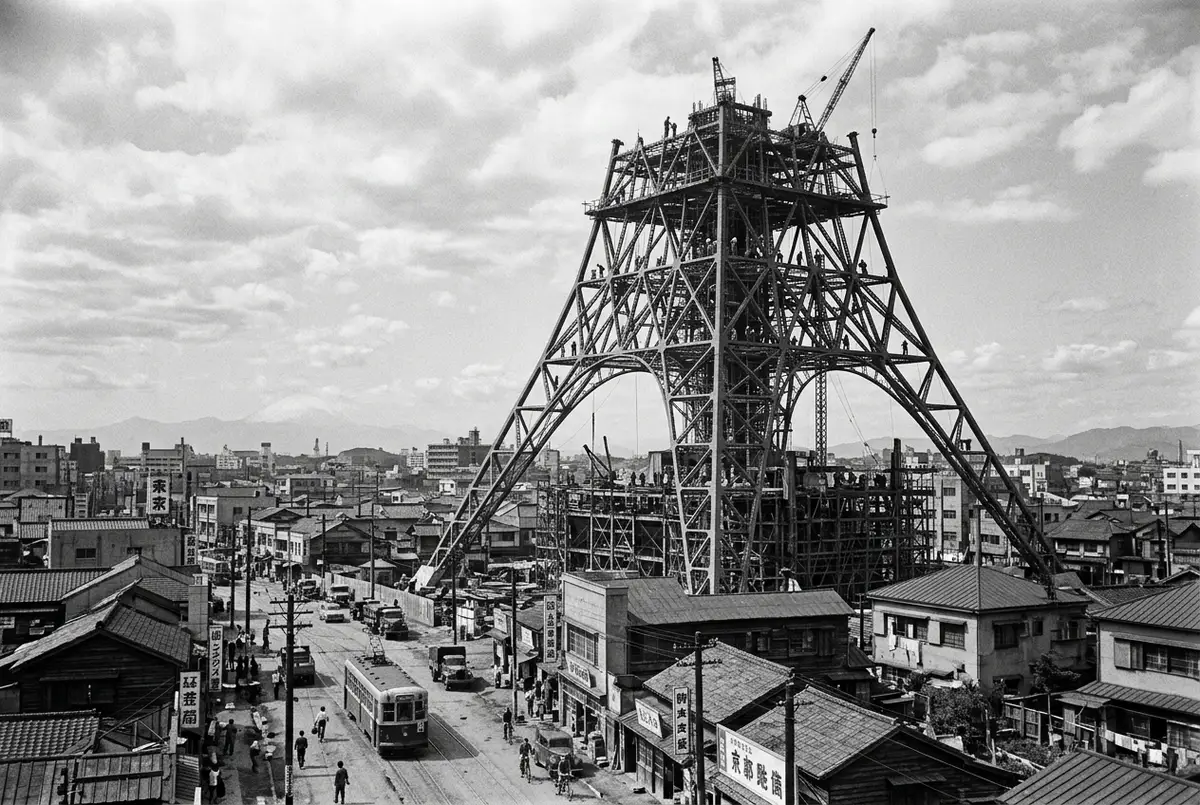
Tokyo Tower was built as a shared broadcasting tower, opening in 1958 so Tokyo's TV stations could transmit from one structure. Television moved to Tokyo Skytree in 2012; Tokyo Tower still carries FM radio.
 Tokyo Tower Admission Ticket: Main Deck and Top Deck From $9.41 · Cheapest way up See dates
On this page 7 sections
Tokyo Tower exists because Tokyo’s television stations each needed their own tower, and that was about to get completely out of hand. Forget the monument story for a second. I’d read the 1958 opening as an infrastructure fix first, one that happened to also become a landmark almost by accident.
The history, in numbers
Source:WikipediaWhy was Tokyo Tower built?
NHK began Japan’s television broadcasting in 1953, and with each broadcaster building its own tower, a single shared one became necessary as more stations piled in. Tokyo Tower became that tower. Later, a symbol of Japan’s postwar growth too, but that came after.
Say you’re standing at the base of the tower trying to picture 1958 Tokyo: every broadcaster running its own separate antenna, a country still putting itself back together. The logic wasn’t symbolic at first, not even close. It was just practical. Individual broadcasters had each built their own towers, and a single combined one became necessary once more stations were expected to launch. The symbolism arrived later, once the tower became a recognized sign of postwar growth in its own right.
When was Tokyo Tower built?
Construction began in June 1957. The antenna was bolted into place on 14 October 1958, and the tower opened to the public on 23 December 1958, at a cost of roughly 2.8 billion yen.
Wikipedia dates the start of construction to June 1957 and the opening to 23 December 1958, with a construction cost of about 2.8 billion yen. That’s roughly $8.4 million back in 1958.
Who designed Tokyo Tower and why does it resemble the Eiffel Tower?
Engineer Tachu Naito designed it, modeled on the Eiffel Tower, but built it about 9 m taller so it could claim the title of world’s tallest freestanding tower at the time. A bit of one-upmanship, basically.
Wikipedia credits Tachu Naito as the designer, with structural engineering by Nikken Sekkei and construction by Takenaka Corporation. Japan Travel also describes it as based on the Eiffel Tower’s design — so the resemblance is deliberate, not some coincidence.
What was Tokyo Tower originally used for?
It was built as a shared broadcasting tower, so Tokyo’s television stations could transmit from one structure instead of running several separate towers.
That single purpose, consolidating broadcast antennas under one roof, is really the whole reason the tower exists at the height it does. A tower tall enough to serve every Tokyo broadcaster at once had to clear the city’s rooftops by a wide margin, no way around it.
What happened to Tokyo Tower in the 2011 earthquake?
The 2011 Tohoku earthquake damaged the tip of the top antenna on 11 March 2011, and the tower’s measured height dropped to 315 m on 19 July 2012 while that antenna got repaired.
Wikipedia records the damage date and the 2012 height reduction during repairs. The tower’s current listed height of 333 m reflects the finished repair. Not an ongoing reduced state, just history now.
How did Tokyo Skytree change Tokyo Tower’s role?
Tokyo Skytree opened in April 2012 and took over as Japan’s tallest structure and the city’s main TV broadcasting tower. So these days Tokyo Tower earns mainly from FM radio antenna leasing and tourism instead.
| Tokyo Tower | Tokyo Skytree | |
|---|---|---|
| Year completed | 1958 | 2012 |
| Original purpose | Shared TV broadcasting | Replacement TV and radio broadcasting |
| What it broadcasts today | FM radio (Tokyo FM, InterFM) | Digital TV and radio |
Wikipedia confirms Tokyo Tower still supports FM radio broadcasting while television moved to Skytree, and GO TOKYO notes Tokyo Tower was Japan’s tallest structure until Skytree surpassed it in 2012. Tourism and antenna leasing fill the gap television left behind, and honestly, it seems to be working out fine.
For the height, weight and paint facts behind the tower, see Tokyo Tower height and facts. The aviation-law colour scheme has its own story too: see why Tokyo Tower is red and white, and for its recurring cameo on screen, Tokyo Tower in anime, film and games. Deciding whether to go up in person? See is Tokyo Tower worth it, or just browse the full Tower Tokyo guide.
Questions
Is Tokyo Tower still used for broadcasting?
Yes, it still supports FM radio broadcasting for Tokyo FM and InterFM, even though television broadcasting moved to Tokyo Skytree in 2012.
How much did Tokyo Tower cost to build?
About 2.8 billion yen, roughly $8.4 million in 1958. Construction ran from June 1957 to the December 1958 opening.
Was Tokyo Tower ever the tallest structure in the world?
It held the title of world’s tallest freestanding tower from 1958 to 1967, and tallest lattice tower from 1958 to 1973 besides. Remained Japan’s tallest structure right up until Tokyo Skytree opened in 2012.
What is Tokyo Tower’s connection to the Eiffel Tower?
Tachu Naito modeled Tokyo Tower on the Eiffel Tower’s design but built it about 9 m taller, just to claim the world’s tallest freestanding tower title. Despite the extra height, it weighs roughly 3,300 tons less.